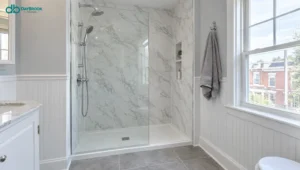

Most bathroom renovations start with a glass of wine and a Pinterest board, but end with you crying over a plumbing estimate. It is a brutal process. You are stuck living in a construction site, trying to shower at the gym while your contractor discovers expensive surprises behind your walls. It is a mess. Before you jump into a one-day shower remodeling project, you have to settle the floor’s situation. Do you stick with a traditional curb or go for a curbless walk in the shower? This is a choice between keeping the water where it belongs or risking a flood for the sake of a modern, barrier-free shower aesthetic.
Social media makes the curbless look like a no-brainer. It is sleek, and it looks like something out of a five-star hotel. But real life isn’t a filtered photo. Before you start ripping up tile, you need to know if a no-step shower is actually a practical choice for your home or just a high-maintenance money pit. If you’re looking for a quick upgrade, a one-day shower remodeling project might be your best bet, but even then, the curb choice is a foundational decision you can’t walk back easily.
The Curbed Shower: Old Faithful for a Reason

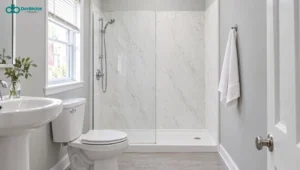
Let’s talk about the traditional walk-in shower curb. You know it; you’ve stepped over it a thousand times. It is that three-to-four-inch bump at the entrance of the shower. While it might feel a bit dated to some, it exists for a very practical reason: it is a dam.
A curbed shower is designed to be a self-contained vessel. The curb acts as a physical boundary that tells the water exactly where it belongs. For most homeowners, this is the “safe” choice. It is easier to build, cheaper to install, and significantly more forgiving if your drain gets clogged with hair, or the showerhead is pointed at a weird angle.

Why You Might Stick with the Curb
The primary draw of a low curb shower is the cost. Since the shower floor is building the subfloor, your contractor doesn’t have to perform major surgery on your floor’s joists. It is a straightforward “drop-in” or “build-up” process.
Water containment is another win. With a curb, you can use a standard swinging door or a sliding track. The seal at the bottom of the door hits the curb, and gravity does the rest. You don’t have to worry about the “death rattle” of water trickling across your bathroom rug because your floor pitch was off by a fraction of an inch.
What is a Curbless Shower, anyway?

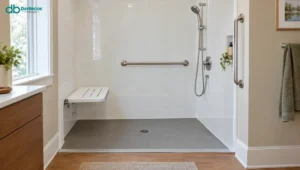
A curbless walk-in shower, also known as a no-threshold shower, is a design where the bathroom floor and the shower floor are on the same level. There is no lip, no step, and no barrier. It is one continuous plane of tile or stone that slopes gently toward the drain.
This is the holy grail of modern shower ideas. It opens up the room, making a tiny bathroom feel twice as large. It is also the gold standard for “aging in place.” If you’re planning on staying in your home long-term, a no-entry shower is a smart move. It eliminates a major trip hazard and makes the shower accessible for anyone using a walker or a wheelchair.
The Engineering Headache Nobody Tells You About
Here is the “real-talk” observation: a curbless shower is an engineering feat, not just a style of choice. To make a shower floor level with the rest of the room, you usually have to lower the floor height inside the shower area. This often means cutting into the floor joists or “recessing” the subfloor.
If you live in a condo with a concrete slab, this becomes an even bigger headache. You might have to build an entire bathroom floor just to create that seamless transition. This is where the budget starts to balloon into a wallet-draining nightmare.
Comparing the Two: A Side-by-Side Reality Check
Feature | Curbed Shower (The Traditionalist) | Curbless Shower (The Modernist) |
Installation Complexity | Low to Moderate. Most contractors can do this in their sleep. | High. Requires precise floor pitching and structural work. |
Cost | Budget-friendly. Standard materials and labor. | Expensive. High labor costs and specialized drainage. |
Water Control | Excellent. The curb is a literal dam. | Risky. Requires a perfect slope and often a linear drain. |
Accessibility | Poor. The step is a trip hazard. | Superior. Perfect for barrier free shower needs. |
Aesthetics | Traditionally. You can look “clunky” in small spaces. | High end. Creates a seamless, expansive look. |
Cleaning | Moderate. Curbs can collect grime in the corners. | Easier. No awkward ledge to scrub, just one flat surface. |
The Drainage Dilemma: Linear vs. Center Drains

If you go the curbless route, the drain is your best friend or your worst enemy. In a standard shower with a curb, you usually have a center drain. The floor slopes from all four corners down to the middle, like a shallow bowl.
In a flat walk-in shower, a center drain can be tricky because the “bowl” shape can create awkward tile cuts and a “lippage” problem where the edges of the tiles don’t line up. This is why most modern curbless shower designs use a linear drain.
A linear drain is a long, narrow grate that usually sits along one wall or right at the entrance. It allows the floor to slope in a single direction. It looks incredible but warned: these drains are pricey. We’re talking five-to-ten-time times about the cost of a standard round drain. But if you want no lip shower to look without the water ending up in your hallway, it is a necessary evil.
The Anatomy of the Curb: It Is More Than Just a Hump
When people talk about a curb shower vs curbless shower, they often treat the curb like a monolith. But the design of that curb matters. If you go with a shower with a curb, you have choices. You can build it out of wood (though that is a recipe for rotting if the waterproofing fails), stacked 2x4s, prefabricated foam blocks.
The smartest way to do a modern shower curb is to cap it with a solid piece of stone. If you use the same quartz or marble as your vanity top, the curb stops looking like a barrier and starts looking like a design feature. It also gets rid of the grout lines on the top of the curb, which is the first place where leaks usually start. Grout is porous; solid stone is not.
The Splash Zone: Dealing with Open Designs
Many people pair a no-step walk-in shower with a “wet room” concept or a single fixed glass panel. While this looks like a million bucks in a showroom, you need to consider the splash factor.
Without a door and without a curb, water is free to roam. If your showerhead has high pressure or you like to move around, you might find that your “dry” area is perpetually damp. This is why waterproofing the entire bathroom floor is often recommended for curbless shower designs. You aren’t just waterproofing a shower; you’re waterproofing a room.
Is a Curbless Shower Actually a Good Idea?

The skeptical expert in me says: it depends on your house and your stage of life.
If you are remodeling a second-floor bathroom in an old house with bouncy wooden joists, a curbless shower might be more trouble than it is worth. The structural modifications could compromise the integrity of the floor, and any slight house settling could crack your grout and lead to leaks.
However, if you are doing a full gut job and plan to stay at home for twenty years, a barrier-free shower is a phenomenal investment. We’re seeing more buyers prioritize accessibility and “universal design.” A shower with no curb isn’t just a trend; it is a shift toward more inclusive living.
The Middle Ground: The Low Curb Shower
If the thought of cutting into your joists makes your heart race, but you hate the look of a massive step, the low shower curb is your sweet spot. These are usually only an inch or two high. They provide enough of a barrier to keep the water in check but are low enough to look sleek and be easy to step over.
A low threshold shower gives you the best of both worlds. You get the reliability of a traditional build with a much more modern, “walk-in” feels. It is also a much easier to install for a one-day shower remodeling crew, as it doesn’t require the massive structural changes that a true no lip shower demands.
Waterproofing: The Hidden Money Pit
You cannot talk about showers without curbs without talking about the “envelope.” In a standard shower, the waterproofing stops at the top of the curb. In a curbless shower bathroom, the waterproofing needs to extend several feet outside the shower area.
If your contractor doesn’t suggest a “tanking” system—where the entire floor is covered in a waterproof membrane—run away. Without a curb, capillary action can pull water under the bathroom tiles. Over time, this leads to the “death rattle” of your subfloor as it rots away silently. This is why curbless vs curb shower debates always come down to the skill of the installer. A bad curb might leak a little; a bad curbless install can ruin your entire house.
Material Science: Tile Choice and Safety
In a flat walk-in shower, the tiles you choose can make or break the experience. Since there is no physical barrier to catching you if you slip, you tile with a high Coefficient of Friction (COF).
Shiny, polished marble is a death trap in a no-step walk-in shower. You want something matte or textured. Small mosaic tiles are popular for curbless showers because the extra grout lines provide a natural grip for your feet. If you’re dead set on large-format tiles to get that seamless look, make sure they are rated for wet environments. If they aren’t, you’re just building a very expensive ice rink.
Resale Reality: Does Anyone Actually Care?
We often hear that a modern curbless shower adds thousands to your home’s value. That is mostly marketing fluff. Most buyers just want a clean, functional bathroom. However, a barrier-free shower does expand your pool of potential buyers.
Think about it this way. A young family won’t be turned off by a curbless shower, but an elderly couple will be turned off by a high-walled tub or a chunky curb. By going with a no-threshold shower, you are making your home “universal.” You aren’t just selling a bathroom; you’re selling peace of mind for the long haul.
Contractor Red Flags: How to Spot a Hack
When you ask a contractor about curbless shower ideas, listen closely to their response. If they say, “Oh, we just slope off the floor a bit,” they are probably going to fail.
A pro will talk about “recessing the subfloor,” “linear drain placement,” and “structural integrity.” They should ask about your joist direction before they even give you a quote. If they don’t seem concerned about how the water stays in the shower without a curb, they aren’t the right person for a no-step shower. This is precision work, not a “wing it” job.
Maintenance and the Grout Nightmare
Let’s get gritty about cleaning. Curbs have corners. Corners collect soap, scum, hair, and that weird pink mold that seems to thrive on neglect. A shower with a curb design means you have more edges to scrub.
On the flip side, a curbless shower bathroom is basically one big floor. If you use large-format tiles, you have fewer grout lines. This makes cleaning significantly easier. You can practically mop your shower floor at the same time you mop the rest of the bathroom.
But and there is always a bit, if you go with a curbless design and don’t have a door, the humidity in the entire bathroom will skyrocket. You’ll need a high-end exhaust fan to prevent the ceiling from peeling or the mirrors from constantly fogging up.
Visualizing the Space: Walk-In Shower Ideas

When you’re looking at types of walk-in showers, think about the “visual weight” of the room. A curb acts as a visual break. It tells the eye where one thing ends, and another begins. In a large bathroom, this is fine.
In a tiny master bath, that curb is a hurdle for your eyes. A walk-in shower with no curb design allows the eye to travel all the way to the back wall. It tricks your brain into thinking the room is larger than it is. Pair this with a floating vanity and a large mirror, and you’ve turned a cramped closet of a bathroom into an airy sanctuary.
Small Bathroom Strategies: Making Curbless Work
Can you put a curbless walk-in shower in a tiny 5×7 bathroom? Yes, but you have to be smart. In small spaces, a damsels shower often means the toilet and vanity are going to get splashed.
The fix is a “wet room” layout where everything in the room is designed to get wet. You hang the vanity on the wall so water can run under it. You use a wall-hung toilet. It is a bold look that is very popular in European design, but it requires a level of waterproofing that most American contractors aren’t used to doing. If you go on this route, make sure your contractor has experience with curb-free shower wet rooms.
The Cost Reality Check: Breaking the Bank
Don’t let a glossy brochure fool you. The price difference between a curb vs curbless shower can be thousands of dollars.
For a standard curbed shower, you’re looking at standard pan liners and basic tile work. For a curbless setup, you have to account for:
- Structural labor: Dropping the floor height or shimming the joists.
- Specialized kits: Systems like Schluter-Kerdi or similar waterproofing membranes.
- Linear drains: The high-end hardware that can cost $500 to $1,000 just for the part.
- Extensive tiling: Often extending the tile throughout the whole bathroom for a cohesive look.
If your budget is tight, the curb is your friend’s. If you have the “reno-fund” to spare, the curbless is the luxury upgrade.
The Luxury Factor: Why We Love the Curbless Look
Despite all the warnings and the costs, there is a reason we keep coming back to the modern curbless shower. It feels like a spa. There is something incredibly liberating about just walking into a shower without having to lift your feet.
It feels intentional. It feels like the room was built around your comfort rather than the limitations of the plumbing. When you combine a walk-in shower with no lips with a rain showerhead and some high-end lighting, you aren’t just cleaning yourself. You’re having an experience. For many, that daily luxury is worth every penny of the “wallet-draining” installation cost.
Glass Choices: Door or Not Door?
A curbless shower doesn’t automatically mean a “doorless” shower. You can still have a glass door on a curbless setup. In fact, if you’re worried about drafts, a glass door is a great idea.
However, many people go with a single fixed panel. This is the ultimate “low maintenance” move because there are no hinges to clean and no tracks to scrub. Just remember that without a door, the “steam” escapes much faster. If you like your shower to feel like a sauna, you might want to stick with a glass door regardless of whether you have a curb or not.
Safety and the Universal Design Movement
Let’s drop the “modern shower curb” talk for a second and talk about reality. Falls in the bathroom are one of the leading causes of injury for older adults. The shower curb is a classic “stumble point.”
A walk-in shower with no lip is more than just a style statement for many families; it is a safety necessity. If you have a family member with mobility issues, a no-step shower is the only way to go. It allows for “roll-in” access, which is a gamechanger for independence. Even if you don’t need it now, the resale value for a home that is already “handicapped accessible” is climbing every year.
Designing the Perfect Shower Curb
If you decide to stick with the curb, don’t just settle for a boring box. A modern shower curb can be topped with a solid piece of stone—like your countertop material—to eliminate grout lines on the top surface. This makes it look more integrated and “intentional” rather than an afterthought.
You can also play with the width. A wider curb can act as a small ledge for a glass partition. Just make sure the curb is pitched slightly inward toward the shower drain, so water doesn’t sit on top of it.
The Concrete Slab Challenge
If your house is built on a concrete slab, a curbless walk-in shower is a different beast entirely. You can’t just cut into a slab without potentially compromising the structure or hitting a tension cable.
If your house sits on a concrete slab, going curbless is a total gut-punch. You are forced to hire a crew to jackhammer with a massive hole in your foundation just to drop the floor low enough for a drain. It is a loud, filthy, wallet-draining disaster that turns your bedroom into a disaster zone for weeks. A low curb is the real-world winner for slab homes. You get the sharp, modern aesthetic you are after without the structural death rattle of sawing a deep trench into your home’s foundation.
Final Thoughts: The Choice is Yours
At the end of the day, the curb vs curbless shower debate comes down to what you value most. If you want a quick, reliable, and cost-effective update, the curbed shower wins every time. It is the workhorse of the bathroom world.
But if you want to push the boundaries of design, if you want a space that feels open and accessible, and if you are willing to pay for the expertise required to pull it off, the curbless walk-in shower is the clear winner. It is a statement that will serve you well for decades.
Frequently Asked Questions
What is a curbless shower?
A curbless shower is a design where the bathroom floor and the shower floor are at the exact same level. There is no lip or step at the entrance. The floor slopes gently toward the drain to keep water contained without needing a physical barrier.
Are curbless showers more expensive to install?
Yes, usually by a significant margin. To create a no step shower, contractors often have to lower the floor joists or build up the entire bathroom floor. You also have to factor in the cost of specialized waterproofing and expensive linear drains.
Do curbless showers leak more than curbed showers?
They do not necessarily leak through the floor if waterproofed right, but they do splash more. Without a curb to act as a dam, water can migrate into the dry area of the bathroom if the floor pitch is not perfect or if your showerhead is poorly aimed.
What is a free barrier shower?
This is another term for a no entry or curbless design. It is specifically designed to remove obstacles for people with mobility issues. It allows a person to walk or roll a wheelchair into the shower area without stepping over a ledge.
Is a low threshold shower a good middle ground?
Absolutely. A low threshold shower usually has a curb that is only one or two inches high. It offers a modern look and better accessibility than a standard four-inch curb while still providing a solid water barrier for your bathroom floor.