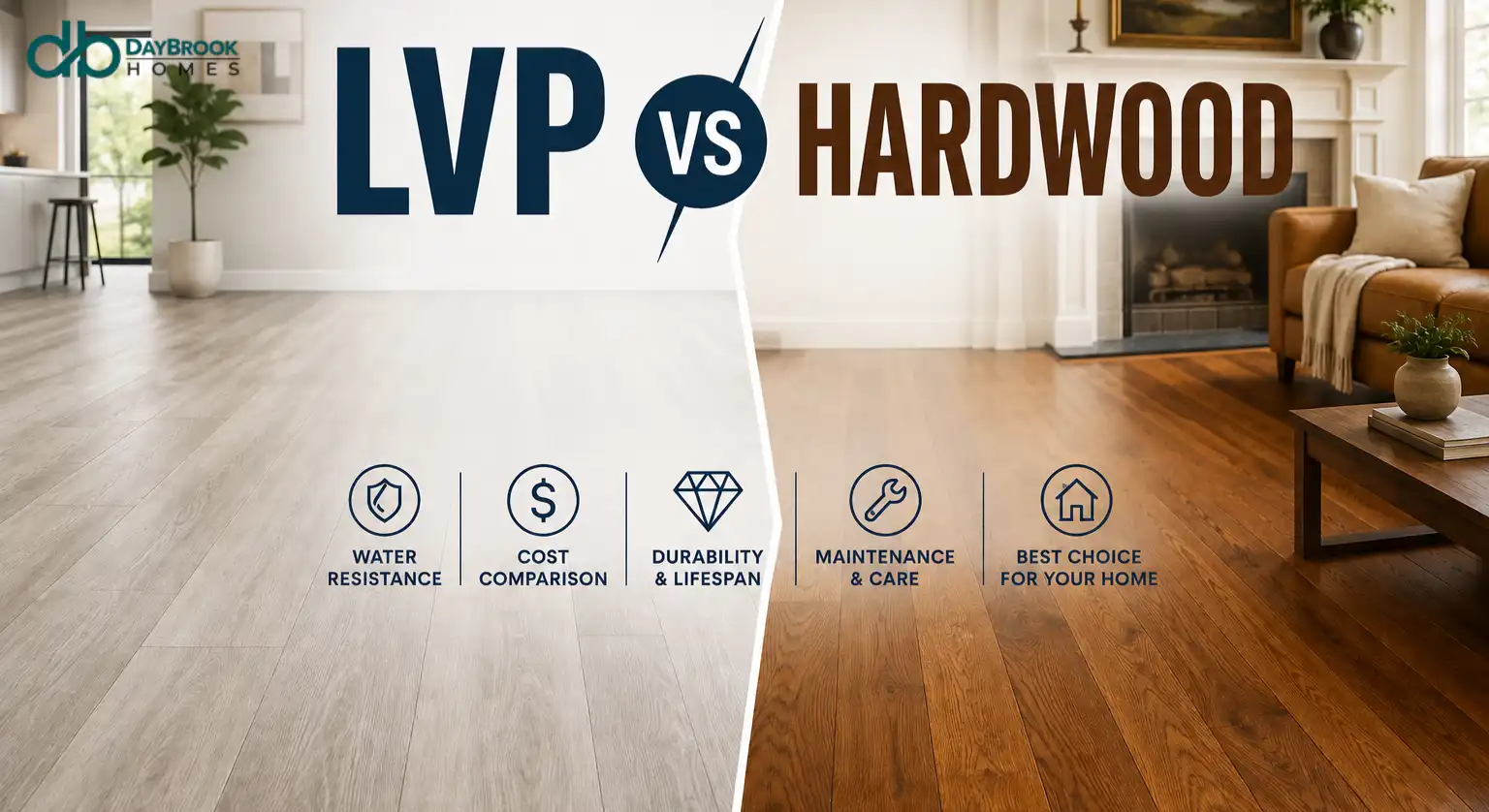
Choosing between LVP vs hardwood flooring feels like a big weight on your shoulders. You want a home that looks amazing. You also want to save money and make sure your floors last. In 2026, the flooring world changed. Technology has made luxury vinyl planks look almost exactly like real wood. Meanwhile, solid hardwood is still the king of home value.
So, which one should you pick? We’re going to check out all aspects from cost and pets to the lifespans of different flooring options. This guide will give you the information to help you figure out which floor accommodates your lifestyle best.
What is LVP and Hardwood?

LVP flooring vs real wood is a fight of the natural versus the artificial. Hardwood flooring is made from trees. It can be either solid wood or engineered hardwood. Solid wood consists of one thick piece of timber. Engineered wood has a real wood veneer on top of a strong core.
On the flip side, luxury vinyl plank is a man-made product. The construction involves several layers including the base of PVC and a top protective layer. Premium models are typically equipped with an SPC core (stone-plastic composite) or a WPC core (wood-plastic composite). Such cores give the flooring a solid and sturdy feel.
LVP vs Hardwood Cost

Money is usually the first thing people think about. When looking at LVP vs hardwood cost, there is a clear winner for your wallet today.
Hardwood is a premium choice. The material cost for real wood floors ranges from $8 to $22 per square foot. Oak hardwood and maple hardwood are common, but walnut flooring can cost even more. The installation labor is also higher because it takes more skill and time.
LVP vs Hardwood Resale Value
If you plan to sell your home soon, pay attention. LVP vs hardwood resale value is a hot topic in 2026.
According to real estate professionals, upgrading to hardwood flooring might see you getting back roughly 118% of your investment when you put your home on the market. A lot of buyers fall in love with the “wow factor” that the solid hardwood brings. They also consider it a fixture of the house that’s there to stay.
On the other hand, the comparison between vinyl plank flooring and hardwood is not as far from each other anymore. In quite a few middle-class areas, the value difference between a house with LVP and one with hardwood is practically nil. Present-day buyers want floors that are both attractive and low maintenance. Actually, both luxury vinyl and hardwood floors could look fabulous in pictures, but the hardwood still earns the highest “prestige” points.
LVP vs Hardwood Durability
If you have a busy house, you need to know about LVP vs hardwood durability. LVP is famous for its scratch resistance and dent resistance. Because it has a plastic layer, it is hard to hurt. This is why many people say LVP is better than hardwood for active families.
Wood flooring is very durable and holds up well over time, however, it is a bit sensitive and can be scratched by heavy furniture or dropped items. In fact, there is a big advantage to wood floors. If after 15 years the floor is worn out and dull, you can simply sand it and make it look new again. You can’t do that with LVP.
LVP vs Hardwood for Pets
Luxury vinyl planks are very hard for a dog or cat to scratch. Most LVP has a 20-mil wear layer that protects the wood-look flooring design. Hardwood or LVP, which is better for pets? Most pet owners choose LVP because it handles accidents better.
If a dog has an accident on solid wood and you don’t see it, the moisture can cause water damage. Vinyl is waterproof flooring, so you don’t have to worry as much.
LVP vs Hardwood for Kitchens and Bathrooms

LVP vs hardwood for kitchens and LVP vs hardwood for bathrooms usually ends with a vinyl victory. High-quality LVP is 100% waterproof. You can spill a whole bucket of water on it, and the SPC core won’t swell.
Hardwood vs luxury vinyl plank in a kitchen is okay when you are careful. But a leaky dishwasher can ruin real wood floors quickly. Moisture resistance is the biggest reason people choose vinyl for “wet” rooms.
LVP vs Hardwood Maintenance

LVP is simple. You can use a wet mop and a basic cleaner. It doesn’t need wax or special oils. Because it is a floating floor with a click-lock installation, there are fewer gaps for dirt to hide in.
Hardwood needs a bit more love. You should only use a damp mop, never a soaking wet one. You also need to watch the humidity in your house. If the air gets too dry, wood can shrink and show gaps.
For the best results with any new floor, check out DayBrook Homes for top-tier service.
LVP vs Hardwood Lifespan
LVP vs hardwood lifespan is a tale of two different paths. A good LVP floor will last 15 to 25 years. After that, you usually must replace it.
Real wood floors can last 100 years. Since you can keep sanding hardwood floors and putting on a new finish, they can outlive the people who bought them. This is why many homeowners consider it a “forever” floor.

LVP vs Hardwood for Rental Property
If you own a rental, you want a floor that a tenant can’t destroy. LVP vs hardwood for rental property usually points toward LVP. It is cheaper to install and almost impossible for a tenant to ruin with water or pets. Plus, if one of the pieces breaks, you can sometimes replace individual replacement planks without doing the whole room.
Frequently Asked Questions
Is LVP better than hardwood for resale?
Hardwood generally adds more total value to a home. However, LVP offers a higher percentage return on what you spend because it is much cheaper to buy and install.
Does LVP scratch easily from dog claws?
No. Most high-quality LVP has a thick layer (20-mil or more) that is very hard for dogs to scratch. It is much more scratch-resistant than most real wood.
Can LVP be installed over existing floors?
Yes! Since most LVP is a “floating floor” with a click-lock system, it can often go right over old tile or wood if the surface is flat and dry.
How much does it cost to install 1,000 sq ft of hardwood?
Including materials and labor, you should expect to pay between $14,000 and $30,000 for high-quality hardwood in 2026. LVP for the same space would cost roughly $5,000 to $10,000.