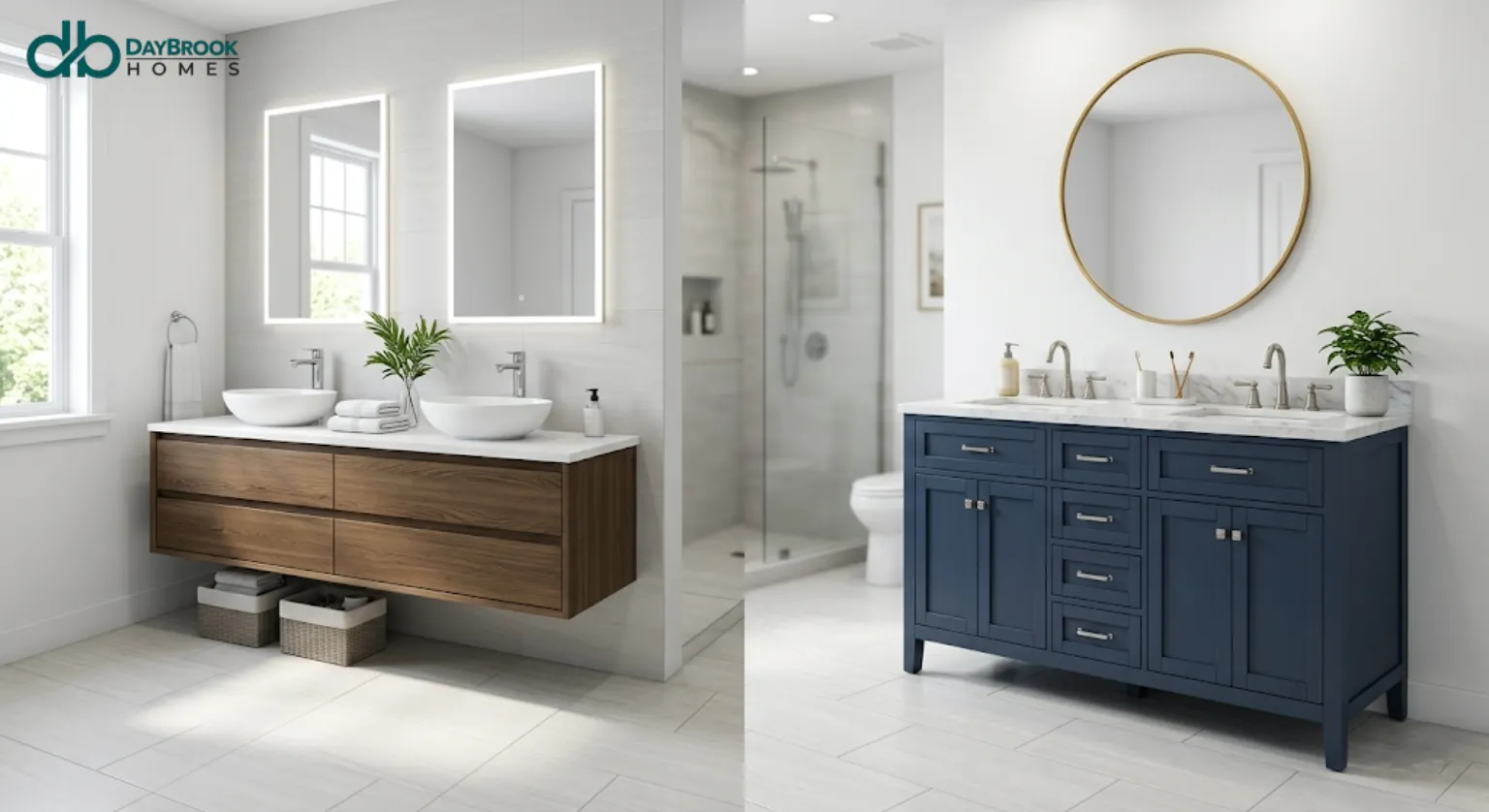
You are remodeling your bathroom or maybe just swapping out that old vanity that has seen better days. The one with the peeling laminate and the drawer that sticks.
Now you are staring at two options. Floating vanity and freestanding vanity. They look different and work differently. Also, one of them might leave you with a serious case of buyer’s remorse.
This is not about what looks cool on Pinterest. It is about what actually works in your space, your budget, and your life. Before we get into the nitty-gritty, here’s the one thing you need to know. The right bathroom vanity depends on your walls, your plumbing, and how much stuff you need to hide.
Not sure which route fits your actual bathroom? Daybrook Homes helps you skip the guesswork. One conversation with straight answers and zero pressure.
What's a Floating Vanity?
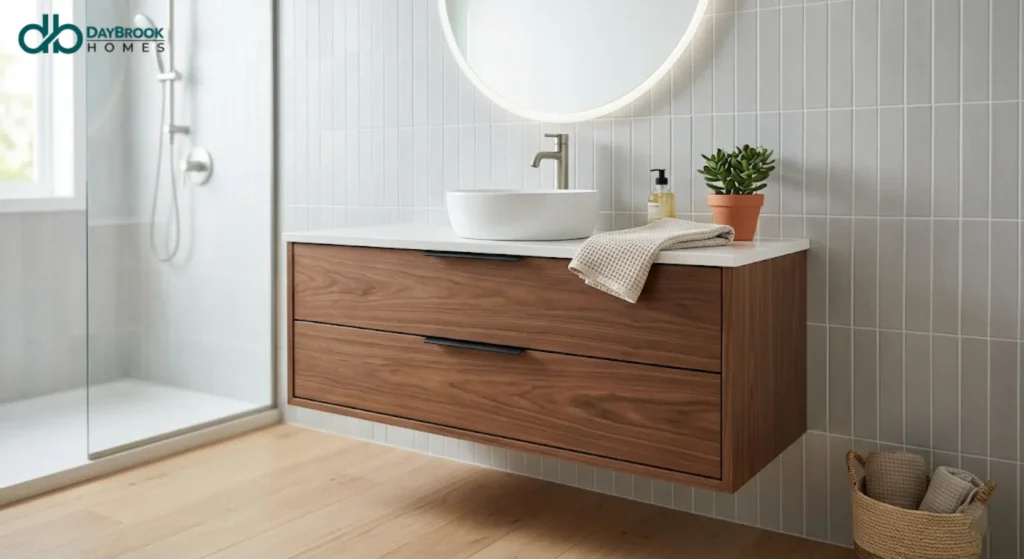
A floating vanity mounts directly to the wall. No legs. No base touching the floor. It hangs there like it is defying gravity.
Looks clean, modern, and high-end.
But there’s a catch. Your wall has to be strong enough to hold it. And everything is inside it. Towels. Cleaning supplies. An extra pack of toilet paper.
Pros of a Floating Vanity
1. Makes small bathrooms look bigger
When you see the floor underneath vanity, your brain thinks the room is larger. Simple trick. Works every time.
2. Easy to clean underneath
Spilled something? Run the mop right under. No toe kick to trap dust bunnies and hair.
3. Adjustable height
You can mount it higher for tall people. Lower for kids. A freestanding vanity is stuck at whatever height the manufacturer picked.
4. Modern look
No arguing about this point. Floating vanities look sleek. If your bathroom style is contemporary or minimalist, this is your move.
Cons of a Floating Vanity
1. Wall must be rock solid
Drywall alone won’t hold a floating bathroom vanity. You need studs. Or plywood backing. Or blocking. If your wall is flimsy, you’re in for a bad time.
2. Plumbing has to be inside the wall
Traditional drains come out of the floor. A floating vanity needs drain lines inside the wall. That means opening up a drywall. Moving pipes. More money.
3. Less storage
No base means no lower cabinet space. You lose that bottom shelf or drawer. If you have a lot of bathroom junk, this matters.
4. Harder to install
Not a weekend project for most people. You need tools. Skills. Patience. Or a contractor with a high hourly rate.
What is a Freestanding Vanity?
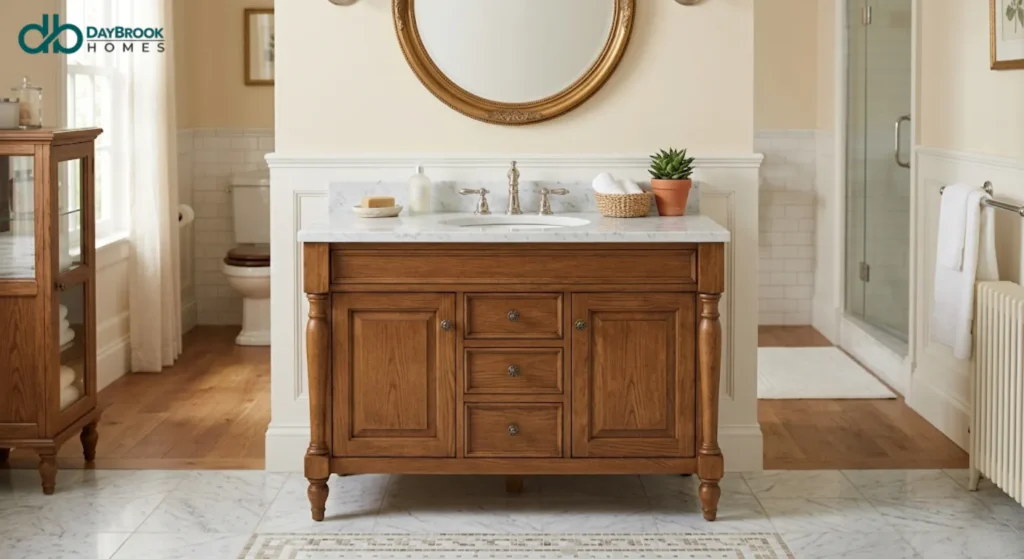
This is a classic. A box on the floor. Four legs or a solid base. It sits there like it owns the place. You’ve seen a thousand of them. They’re everywhere for a reason.
Pros of a Freestanding Vanity
1. Easy installation
Set it in place. Level it. Hook up the water and drain. Done. No wall mounting drama.
2. More storage
Full base cabinet means more room for stuff. Towels. Hair dryer. That random bottle of cleaner from 2019.
3. Plumbing friendly
Drain comes up through the floor or bottom of the cabinet. No wall work is needed. Keeps costs down.
4. Works on any wall
Studs do not matter because the floor holds weight. Your wall could be cardboard, and it would not be cared for.
5. Classic look
Never goes out of style. Fits farmhouse, traditional, transitional, even some modern spaces.
Cons of a Freestanding Vanity
1. Harder to clean around
That gap underneath? Dust. Hair. Spilled toothpaste. You have to get on your hands and knees to wipe it out.
2. Takes up visual space
A big box on the floor makes a small bathroom feel smaller. No open floor area tricks your eye.
3. Fixed height
Most are around 32 to 34 inches tall, which is fine for average height. But if you are tall or have mobility issues, it is not adjustable.
4. Can wobble on uneven floors
Old houses have been settled. Floors slope. A freestanding vanity might rock. You’ll need shims. Annoying but fixable.
Side by Side Comparison
Let’s put them next to each other so you can see the tradeoffs.
Installation difficulty | High | Low |
Storage space | Less | More |
Cleaning underneath | Easy | Hard |
Wall requirement | Strong, studs | None |
Plumbing cost | Higher (wall work) | Lower (floor drain) |
Height adjustable | Yes | No |
Best for small bathrooms | Yes | No |
Best for large bathrooms | No | Yes |
Average cost (vanity only) | $300 – $1,200 | $150 – $800 |
Installation cost | $400 – $1,000 | $150 – $400 |
These numbers are rough. Location and materials matter, but they give you a ballpark.
What Nobody Tells You About Floating Vanities
Here’s the part that hurts.
You buy a nice floating bathroom vanity. $600. It looks great. Then you open your wall to move the drain. $500. Then you realize you need to add blocking between studs. Another $300. Then you pay someone to patch the drywall. $200.
Suddenly your $600 vanity cost you $1,600. And that’s before the countertop and sink. I’m not saying don’t do it. I’m going to know what you’re getting into. A floating vanity is a commitment like adopting a puppy which is cute but expensive.
What Nobody Tells You About Freestanding Vanities
They are not magic either. That little toe-kick recess at the bottom? It is a magnet for dust, hair, and grime, so you’ll be down on the floor wiping it out more often than you think.
And if your bathroom floor isn’t perfectly level, the whole vanity can rock every time you lean on the sink. It is nothing a few shims cannot fix, but you will still notice the wobble, and it will bug you until you do.
Also, the classic look can be read as “builder grade” if you pick the wrong one. Avoid flat-panel doors and cheap laminate. Spend a little more on a shaker-style or solid wood.
Which One Should You Pick?
Ask yourself these four questions.
- How strong aremywalls?
If you have solid studs where you want vanity, floating is possible. If you have metal studs or weird spacing, stick with freestanding. - What’smyplumbing situation?
Drains coming up from the floor? Freestanding is easier. Drains already on the wall? Floating might work without major surgery. - How much storage doIneed?
One person with minimal products? Floating works. Family of four with twelve different shampoos? Get freestanding. - What’smybudget?
Under $800 all in? Freestanding. Over $1,500? Floating is doable.
A Few More Things to Consider
1. Kids and floating vanities
Kids lean on things. Hang away from things. A floating vanity is solid if installed right. But the visual of nothing underneath might tempt a toddler to sit there. Just saying.
2. Mobility issues
If someone in your house uses a wheelchair or walker, a floating vanity is a game-changer. They can roll right under it. No base on the way.
3. Resale value
Floating vanities look high-end; some buyers love that; some think they are weird. Freestanding is safer for resale. Nobody walks away from the house because of a normal bathroom vanity.
You can read all the pros and cons in the world. But at some point, you need someone to look at your space and tell you what works. DayBrook Homes does that. No hard sell, just real advice from people who actually install this stuff for a living. Go talk to them before you order something you regret.
Still Confusing Between Floating or Freestanding?
Our design experts help you choose the perfect vanity to maximize space and style in your bathroom remodel.
Get Your Free ConsultationThe Bottom Line
Here is what I tell my friends when they ask about bathroom vanity choices. If you have the wall structure, the budget, and the desire for a modern look, go floating. Just be ready for the hidden costs. If you want something that works, stores your stuff, and won’t blow your budget, go freestanding. It’s boring but it works.
And if you’re still stuck? Walk into a bathroom showroom, put your hands on both, and open the drawer. Sit on the toilet next to them to see how they feel in real life.Because bathroom vanity is not just a piece of furniture. It’s the thing you lean on every morning while you brush your teeth. Pick the one that won’t annoy you six months from now.
Frequently Asked Questions
What's the main difference between a floating and freestanding bathroom vanity?
A floating vanity mounts to the wall with no floor contact. A freestanding vanity sits on the floor like a cabinet.
Which bathroom vanity is easier to install?
Freestanding. Set it in place, level it, hook up plumbing. Floating needs strong walls and often wall plumbing changes.
Does a floating bathroom vanity cost more?
Yes. The vanity itself can cost more, but the real hit is installation and plumbing wall work. Add $500 to $1,000 easily.
Which bathroom vanity offers more storage?
Freestanding. The full base cabinet gives you more drawers and shelves. Floating has no lower storage.
Is a floating bathroom vanity good for small bathrooms?
Yes. The open floor underneath makes the room look bigger. Easier to clean, too.